Come on it’s all about stopping the illegals, an app for UK citizens only. That’ll maybe come in handy if an illegal tries to get a job at somewhere legit like Barclays bank, you know, like never happens.
Where’s this petition then? I feel like wasting 5 minutes
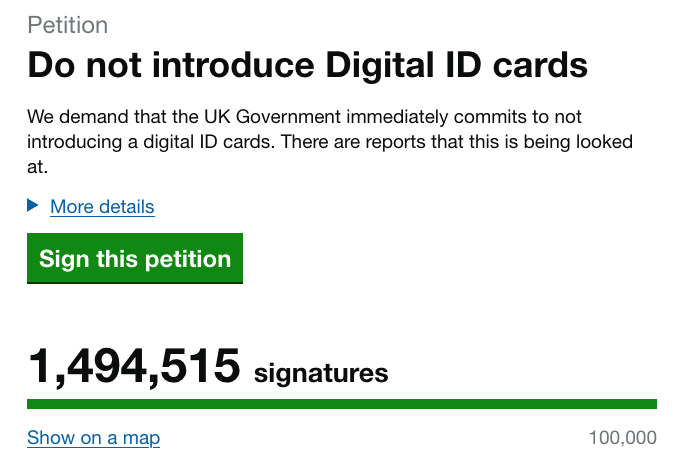
Is there’s one good thing about this I think it’s probably that it unites both left and right wing in opposition 
2 Likes
Really good arguments against here. I clearly haven’t thought this through hard enough and trust government too much!
1 Like
One thing you posted @Mark that stuck out to me is how you mention your email and phone is in one place… both things that are essentially loaned to you by companies in most instances.
No your post was sensible and made me wonder if people are being para.
I think brits are just anti authoritarian at heart. No-one wants to ever hear the phrase “papers please”
1 Like
I don’t understand what you’re getting at…that it’s just a thing you don’t own or something else?
I’m not sure myself. Ha.
I guess it’s part of tying certain things to a digital id that aren’t really necessarily static or yours. In my mind it highlights the difference between that and a drivers licence which isn’t explicitly tied to that stuff.
1 Like
Oddly it kind of is tied to you in a roundabout way - here everyone gets their own government assigned official email address. This is as residents are expected to have email and to be able to receive government communications. Everyone uses the forwarder to their usual email though.
AFAIK certain branches are only able to access certain information. So you can’t join a far right party with your ID and they suddenly get all your health/prescription/address information.
I asked Gemini about it:
Estonia’s Digital ID: What Companies Know When You Use It as a Loyalty Card
When you use your Estonian government-issued ID card to authenticate with a company for a loyalty program, the information shared is minimal and strictly controlled, adhering to the principle of data minimization. The company does not gain access to your entire government profile. Instead, the data transfer is limited to what is necessary for the specific service, and your consent is paramount.
Typically, the information a company receives upon your authentication includes your full name and your unique Estonian personal identification code (isikukood) .1 This code, a non-sensitive 11-digit number, is used as a reliable identifier to link you to your loyalty account. In some cases, depending on the service and with your explicit consent, your date of birth may also be shared.
The technical process is designed to be highly secure.2 When you use your ID card, either physically with a card reader or through its mobile or smart-ID versions, the authentication is handled by a trusted third-party service provider, such as SK ID Solutions. This process involves public key encryption, where your private key for authentication never leaves the chip of your ID card or the secure element of your SIM card.3 The company you are authenticating with only receives a confirmation of your identity along with the pre-agreed-upon personal data points.
How the Government Protects Your Sensitive Information
The Estonian government employs a robust legal and technological framework to safeguard your sensitive information and prevent its misuse. This framework is built on the following key pillars:
Legal and Regulatory Safeguards:
- General Data Protection Regulation (GDPR) and the Personal Data Protection Act (PDPA): Estonia’s data protection laws are in strict compliance with the EU’s GDPR.4 These regulations mandate that personal data can only be processed with a clear legal basis, such as your explicit consent.5 The “principle of minimalism” is a core tenet, meaning that companies are only allowed to request and process the data that is absolutely necessary for the service they are providing.6
- Informed Consent: For a company to access your personal data through your ID card, you must provide informed consent. This means the company must clearly state what information they are requesting and for what purpose. You have the right to refuse this request.
- Data Protection Inspectorate (Andmekaitse Inspektsioon): This independent public authority is responsible for overseeing the implementation of data protection laws in Estonia.7 It has the power to investigate and sanction any organization that violates these regulations, ensuring that companies are held accountable for how they handle personal data.
Technological and Infrastructural Security:
- X-Road: The backbone of Estonia’s e-government is a secure data exchange layer called X-Road.8 This decentralized system ensures that data is not stored in a central database. Instead, it facilitates secure and logged communication between different government and private sector databases.9 When a company needs to verify your information, it sends a query through X-Road, and only the necessary and authorized data is returned. You, as a citizen, can log into the state portal (eesti.ee) and see which entities have accessed your data.10
- Public Key Infrastructure (PKI): The entire ID card system is based on a sophisticated PKI.11 Your ID card contains two separate certificates with corresponding private keys: one for authentication (logging in) and one for digital signatures.12 These private keys are generated and stored securely on the card’s chip and are never accessible to any third party, including the government or the company you are interacting with.13
- Secure Authentication Methods: To use your ID card for authentication, you need to enter your personal PIN codes (PIN1 for authentication, PIN2 for digital signatures).14 This two-factor authentication adds a crucial layer of security, ensuring that even if your card is lost or stolen, it cannot be used without your unique codes.
- Data Minimization by Design: The system is designed to share only the essential information required for a transaction. The authentication service confirms your identity to the company without revealing unnecessary personal details.
In essence, when you use your Estonian ID card for a loyalty program, you are not handing over a key to your entire digital life. Instead, you are using a highly secure and regulated tool that allows for the controlled and consented sharing of a minimal amount of information, all under the watchful eye of a dedicated data protection authority. This combination of strong legal frameworks and advanced technology ensures that your sensitive information remains protected from unauthorized access.15
If you have to pay for something online you can do so with traditional credit cards/paypal etc or more commonly a bank link. It can work via SMS, with your physical card or via an ID app on your phone. I usually use the ID app. It works like this:
- On the payment page you’re given a selection of Estonian banks with which to pay with
- You enter your ID number
- It sends a notification to your phone and the app opens up (even if your phone is locked)
- You type in your government PIN (this identifies you as you)
- You confirm the amount to pay and then ‘sign’ the contract with a second, longer government PIN (this is your signature)
- That’s it
So there’s no messing about with bank cards or anything, you’re talking directly to the bank with something as good as a passport to prove who you are.
In shops you still need a bank card or NFC via phone etc.
Coming so quick on the heels of the online safety act, it’s definitely making people feel like the government is overreaching into our lives.
Making it compulsory to give your info to an outsourced company to get an online ID to watch porn just before introducing a mandatory digital ID card was probably the wrong way around to do it. People don’t trust that and now they don’t trust this.
But Tony Blair says that the government have only been so shit for so long because they haven’t had enough power…so the answer is clearly to give our monumentally shit government way more power and that will fix everything!
Probably useful to have some kind of proof of ID on your phone to save having to take pictures of your passport, birth certificate, utility bills etc.
Exactly. It seems completely bonkers to signal this intention now, one, you’ll surely want to show a bit of competence with other more important matters first, two, how many data leaks are we seeing at the moment, it feels like one a week at this point. The timing is way out on this.
As if Reform didn’t need anything more to increase their support, they could just take the opposing stance on this and they’ll be getting even more votes.
It reminds me slightly of whenever the Tories came out with some kind of bold intention in recent years and it just gave the media and public even more encouragement to stick the boot in.
I’m really starting to think Starmer doesn’t give a shit anyway. He’s there to get through a series of new laws directed from the security services. He’ll then move on once his mission is completed
It’s a de-Laboured govt. I hope I’ve read it all wrong and I’m way off…
2 Likes
Here’s one
https://www.telegraph.co.uk/news/2025/09/26/public-inquiries-stopping-spies-from-doing-their-job/
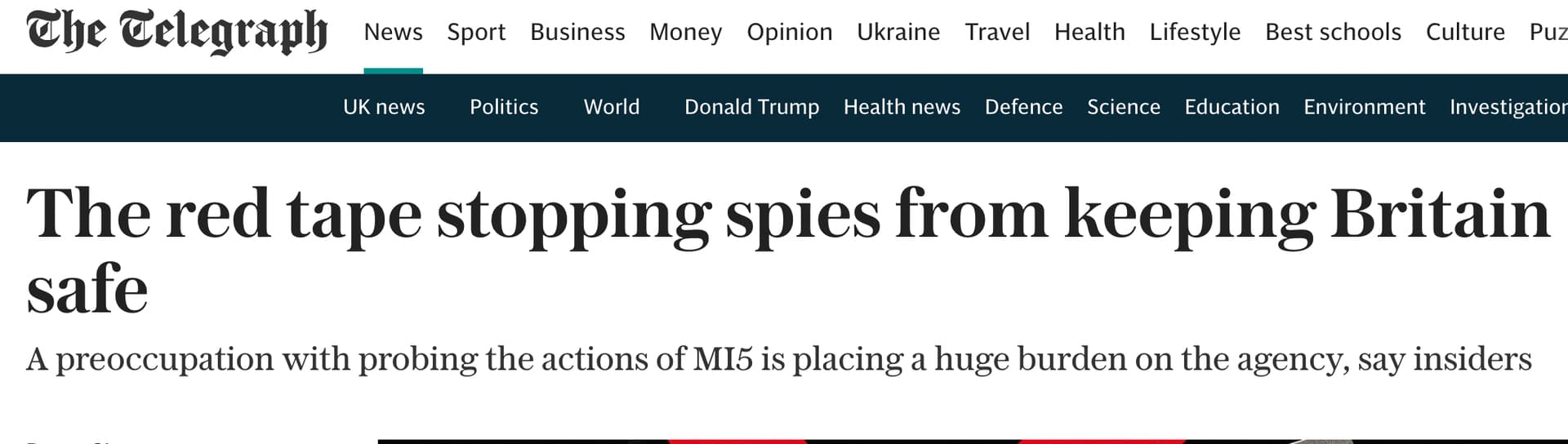
Yahoo link should work

It’s all just a ploy by bravissimo to get people off the net and looking at the websites and raise subscriptions to the physical, non traceable paper catalogues.
Well played, if you asked me
1 Like
This reads like something a bot crawling the web posting positive things about the scheme would pop up and say
1 Like